Developer's Log
Why Local Service Businesses Can't Afford a 'Good Enough' Website
A slow, generic website costs a local service business more than it costs almost anyone else. Here's why the math, the search behavior, and the trust signals are different — and what actually works.
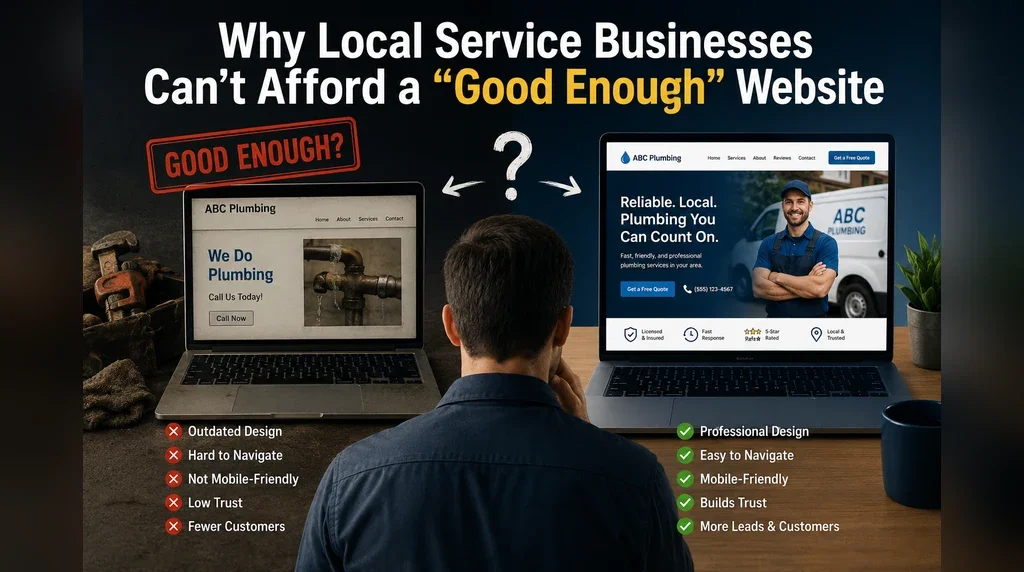
If you run an electrical company, a hair salon, a plumbing outfit, or a restaurant, you’ve probably had this thought at some point: my website is fine.
It loads. It has your phone number on it. Somebody’s cousin built it a few years ago, or you threw one together yourself on a template site over a weekend. It’s not broken. So it’s fine.
Here’s the problem. “Fine” is a much lower bar for a local service business — trades, salons, restaurants, anyone whose business happens in person, on a schedule, with a customer who has to trust you before they show up — than it is for almost anyone else selling something online. The stakes are different, the way people find you is different, and the trust you need to earn before someone hires you, sits in your chair, or books your table is different. A “fine” website quietly costs these businesses more than it costs most others — and most owners never see the damage because it doesn’t show up as an error message. It shows up as a phone that doesn’t ring, or a table that stays empty on a Friday night.
The Math Is Different When One Customer Is Worth Thousands
Think about what a missed lead actually costs.
If you run an online shop selling $40 candles, a slow website that loses you a sale costs you $40. Annoying, but survivable. You lose a handful and move on.
For a trades business, the math is obvious. A missed electrical call could be a panel upgrade worth $8,000. A missed HVAC call could be a full system replacement worth $15,000 to $25,000.
For a salon or a restaurant, the number looks smaller at first glance — a haircut is $80, a dinner for two is $120 — but the real number is the customer’s lifetime value, not one visit. A stylist who books a new client every six weeks is looking at $600+ a year, and most people stay with a stylist for years once they find one they trust. A regular who eats at your restaurant twice a month is worth thousands over time, plus whoever they bring with them and whoever they tell. A slow, confusing site doesn’t just cost you tonight’s reservation. It costs you the customer who would have kept coming back for the next five years.
Every other business type deals with volume. Local service businesses — trades and otherwise — deal with value, whether it shows up as one big job or one loyal regular. A website built for volume — fast checkout, endless product grids, discount pop-ups — is the wrong tool. A website built for value needs to do one job extremely well: make it effortless for a high-intent visitor to book, call, or reserve.
How People Actually Find You Is Different, Too
Here’s a search behavior difference that gets overlooked constantly, and it plays out differently depending on what you do.
Almost nobody discovers a plumber by scrolling. When someone needs a plumber, it’s because water is where water shouldn’t be. That’s high-intent, urgent search — it happens on Google, right now, not on a social feed.
A hair salon or a restaurant is a little different. People genuinely do discover both by scrolling — a stylist’s portfolio on Instagram, a plate of food that looks good at 7pm. Passive discovery is real for these businesses in a way it isn’t for an electrician.
But scrolling only gets you attention. It doesn’t get you the booking. The moment someone likes what they see, the very next thing they do is search — “hair salon near me,” “[restaurant name] menu,” “[restaurant name] hours tonight” — to confirm you’re real, find out if you’re open, and decide whether to commit. That search almost always lands on your website or your Google Business Profile, not your Instagram feed. If what they find there is slow, outdated, or missing basic information, the interest generated by that scroll evaporates right there. You paid for the attention. A weak website is where it goes to die.
A Facebook or Instagram following doesn’t replace this step for anyone — trades, salon, or restaurant. It just changes what happens right before someone lands on your site.
The Trust Problem Nobody Talks About
There’s a piece of this that has nothing to do with speed or search rankings and everything to do with psychology.
Hiring a trades business means letting a stranger into your house to do something you can’t fully evaluate yourself. Booking a hair appointment means trusting a stranger with your appearance for the next two months. Choosing a restaurant means trusting a kitchen you’ll never see with your family’s dinner. Different businesses, same underlying decision: a customer committing to something they can’t verify in advance, based on the impression you make before they ever show up.
A slow, outdated, or generic-looking website raises a quiet but real question: if this business doesn’t take its own presentation seriously, how carefully are they going to take care of me? That doubt doesn’t get spoken out loud. It just shows up as someone quietly closing the tab and picking the next name on the list.
This matters more for these businesses than for most others, because so much of what you’re actually selling — skill, cleanliness, taste, care — is invisible until the moment you’re already committed. You can’t watch someone wire a panel correctly, taste the food before you order it, or judge a haircut before it happens. The website is often the only tangible signal of competence a potential customer gets before they commit.
What Actually Works for This Kind of Business
None of this means these businesses need something flashy. They need something functional, fast, and built around how people actually search for and hire, book, or reserve with them.
Speed on mobile, specifically. Most of these searches happen on a phone — someone standing in a leaking basement, someone deciding where to eat while already in the car. A site that takes four or five seconds to load has already lost a chunk of that traffic before a single word gets read.
Local search visibility that’s actually structured, not just claimed. A Google Business Profile matters, but the website itself needs to tell Google — in a machine-readable way — exactly what services you offer, where you operate, and what makes you a legitimate local business. That’s what structured data does. Without it, you’re invisible to a huge share of local, AI-powered search results that are becoming more important every month.
A phone number, booking link, or reservation button that’s impossible to miss. Sounds obvious. It’s shocking how often it isn’t true. If someone has to hunt for how to contact you, most won’t bother.
Real proof, not stock photos. Before-and-after project photos, a real portfolio of cuts and color work, an actual menu with actual dish photos, licensing and insurance information, real reviews — anything that closes the trust gap mentioned above. These businesses have some of the best “proof” available of any industry, and most websites bury it or leave it out entirely.
A path from visitor to booked customer that takes seconds, not clicks. No forms with twelve fields. No burying the contact page or the reservation link three menu levels deep. The visitor already decided they’re interested. The site’s only job at that point is to get out of the way.
Why We Like Building for This World
There’s a reason this kind of work fits well with how we build.
Skilled trades, salons, restaurants, and custom web development have more in common than people assume. All of them are built on doing the unglamorous, foundational work right — the wiring behind the wall, the prep before service, the code behind the page — even though the customer will never see it directly. All of them get judged, unfairly or not, by people who can’t evaluate the real skill involved and have to rely on trust signals instead. And in all of them, cutting corners doesn’t show up immediately. It shows up later, at the worst possible time.
We hand-code every site instead of using a template builder for the same reason a good electrician doesn’t wing a panel install, or a good chef doesn’t skip mise en place. It’s slower up front. It holds up better under pressure. And it’s the difference between something that looks fine on the surface and something that’s actually built right.
If your website is technically “fine” but you’re not sure whether it’s actually working for you, that’s exactly the kind of thing worth checking rather than guessing about. Get in touch and we’ll give you a plain-English breakdown of your PageSpeed score, mobile performance, local SEO gaps, and structured data. No jargon. No obligation.
Direct: (860) 222-1444
Randy Tarasevich
Founder, Shoreline Web Solutions
Randy is a web developer, business educator, and founder of Shoreline Web Solutions — a custom web development studio based in Old Lyme, CT. He has spent four years building performance-first websites for small businesses using Astro.js, Tailwind CSS, and Cloudflare Workers, and previously taught business courses at the college level for eight years.